Java Object Cache Concepts
Oracle9iAS offers the Java Object Cache to help e-businesses manage Web-site performance issues for dynamically generated content. The Java Object Cache improves the performance, scalability, and availability of Web sites running on Oracle9iAS.
By storing frequently accessed or expensive-to-create objects in memory or on disk, the Java Object Cache eliminates the need to repeatedly create and load information within a Java program. The Java Object Cache retrieves content faster and greatly reduces the load on application servers.
The Oracle9iAS cache architecture includes the following cache components:
- Oracle 9iAS Web Cache. The Web Cache sits in front of the application servers (Web servers), caching their content and providing that content to Web browsers that request it. When browsers access the Web site, they send HTTP requests to the Web Cache. The Web Cache, in turn, acts as a virtual server to the application servers. If the requested content has changed, the Web cache retrieves the new content from the application servers.
The Web Cache is an HTTP-level cache, maintained outside the application, providing very fast cache operations. It is a pure, content-based cache, capable of caching static data (such as HTML, GIF, or JPEG files) or dynamic data (such as servlet or JSP results). Given that it exists as a flat content-based cache outside the application, it cannot cache objects (such as Java objects or XML DOM--Document Object Model--objects) in a structured format. In addition, it offers relatively limited post-processing abilities on cached data.
- Java Object Cache. The Java Object Cache provides caching for expensive or frequently used Java objects when the application servers use a Java program to supply their content. Cached Java objects may contain generated pages or may provide support objects within the program to assist in creating new content. The Java Object Cache automatically loads and updates objects as specified by the Java application.
- Web Object Cache. The Web Object Cache is a web-application-level caching facility. It is an application-level cache, embedded and maintained within a Java Web application. The Web Object Cache is a hybrid cache, both Web-based and object-based. Using the Web Object Cache, applications can cache programmatically using API calls (for servlets) or custom tag libraries (for JSPs). The Web Object Cache is generally used as a complement to the Web cache. By default, the Web Object Cache uses the Java Object Cache as its repository.
A custom tag library or API allows you to define page fragment boundaries and to capture, store, reuse, process, and manage the intermediate and partial execution results of JSP pages and servlets as cached objects. Each block can produce its own resulting cache object. The cached objects can be HTML or XML text fragments, XML DOM objects, or Java serializable objects. These objects can be cached conveniently in association with HTTP semantics. Alternatively, they can be reused outside HTTP, such as in outputting cached XML objects through Simple Mail Transfer Protocol (SMTP), Java Messaging Service (JMS), Advanced Queueing (AQ), or Simple Object Access Protocol (SOAP).
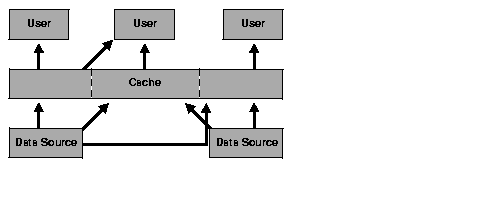
Cache Basic architechture

No comments:
Post a Comment